Peer review
How to respond to reviewer comments: a practical guide
A decision of “major revision” or “minor revision” is good news. The editor sees enough value in the paper to give you a chance to improve it, and most revised manuscripts that respond fully to the comments go on to be accepted. How you respond matters as much as what you change.
First, read the decision letter carefully
Read the editor’s letter before the reviewers’ comments. Editors often signal which points matter most, and sometimes say explicitly that one reviewer’s request is optional. Note the deadline and any formatting requirements for the revision.
Then give yourself a day before replying. Critical comments are easier to assess calmly once the first reaction has passed.
Organise every comment
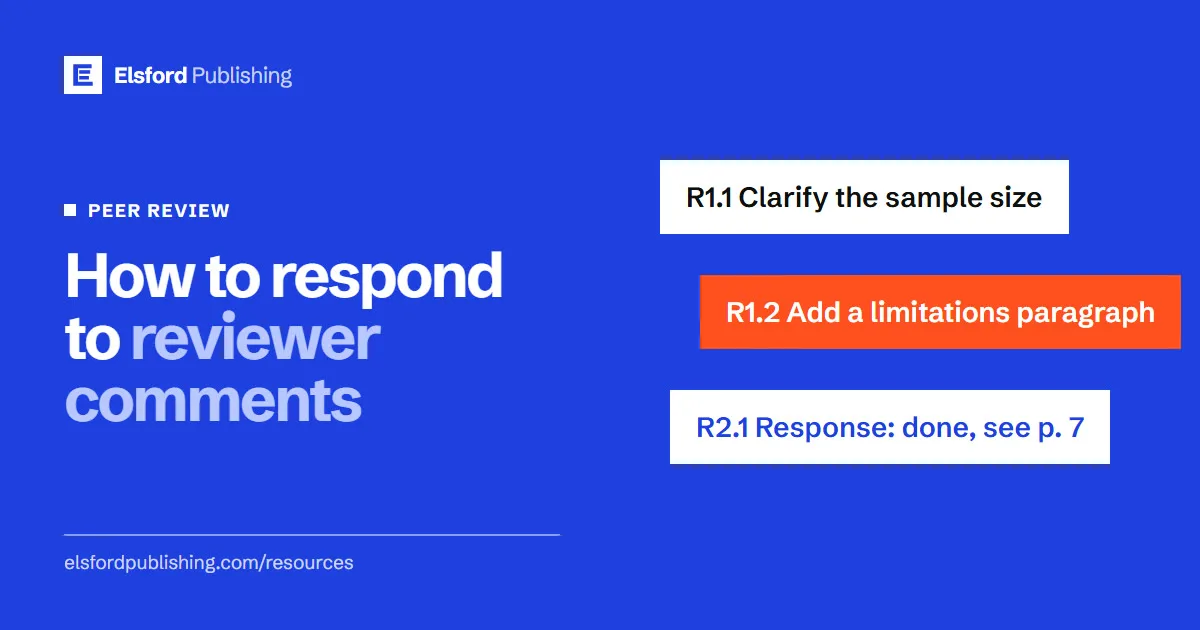
Copy every comment into a single document, numbered by reviewer: R1.1, R1.2, R2.1 and so on. Split long paragraphs that contain several requests into separate points. For each one, decide:
- Agree and change: most comments.
- Agree, but cannot fully change: for example, data that cannot be collected now. Explain the limitation and acknowledge it in the manuscript.
- Respectfully disagree: with evidence, and only where you are confident.
Structure the response letter
A clear response letter makes the editor’s assessment easy. For each comment, include three parts:
- The reviewer’s comment, quoted in full.
- Your response, courteous and specific.
- The change, with page and line numbers, or the revised text itself.
For example:
Reviewer 1, comment 3: The sample size appears small for the subgroup analysis.
Response: Thank you for this point. We agree the subgroup analysis is exploratory. We have now stated this explicitly, reported confidence intervals for each subgroup and added the limitation to the Discussion.
Change: Methods, page 7, lines 152–155; Discussion, page 14, lines 310–318.
Open the letter with a short thank-you and a summary of the main changes. Close it by thanking the reviewers again.
When you disagree with a reviewer
Disagreement is acceptable when it is evidence-based and polite. Thank the reviewer, explain your reasoning, cite the literature that supports it, and where possible make a small change that addresses the underlying concern, for example a sentence clarifying why you chose your approach. Never dismiss a comment or ignore it.
If two reviewers ask for opposite things, explain the conflict to the editor and state which approach you took and why.
Common mistakes to avoid
- Changing the manuscript without saying where. The editor should never have to search for your revisions.
- Responding to the tone rather than the substance. Stay factual even if a comment feels unfair.
- Missing a comment. Check the count of responses against the count of comments before you submit.
- Adding new analyses nobody asked for. It can open new questions. Keep changes focused on the review.
- Submitting late. If you need more time, ask the editor before the deadline.
Files you will usually need
Most journals ask for a response letter, a version of the manuscript with changes highlighted or tracked, and a clean version. Check the journal’s revision instructions, as requirements differ.
A careful response often makes the difference between one round of revision and two, which matters for your publication timeline. If you would like help organising the comments and preparing the response letter, see our reviewer response support.
Want a second opinion on your manuscript?
Send it for a free assessment. We will tell you honestly where it stands and which journals suit it.
Request a free assessment