Planning
How long does it take to publish a research paper?
It is one of the first questions researchers ask, usually because a deadline is approaching: a thesis submission, a promotion file or a grant report. The honest answer is that it depends mostly on the journal, but the stages are predictable, and knowing them lets you plan.
The stages, and how long each usually takes
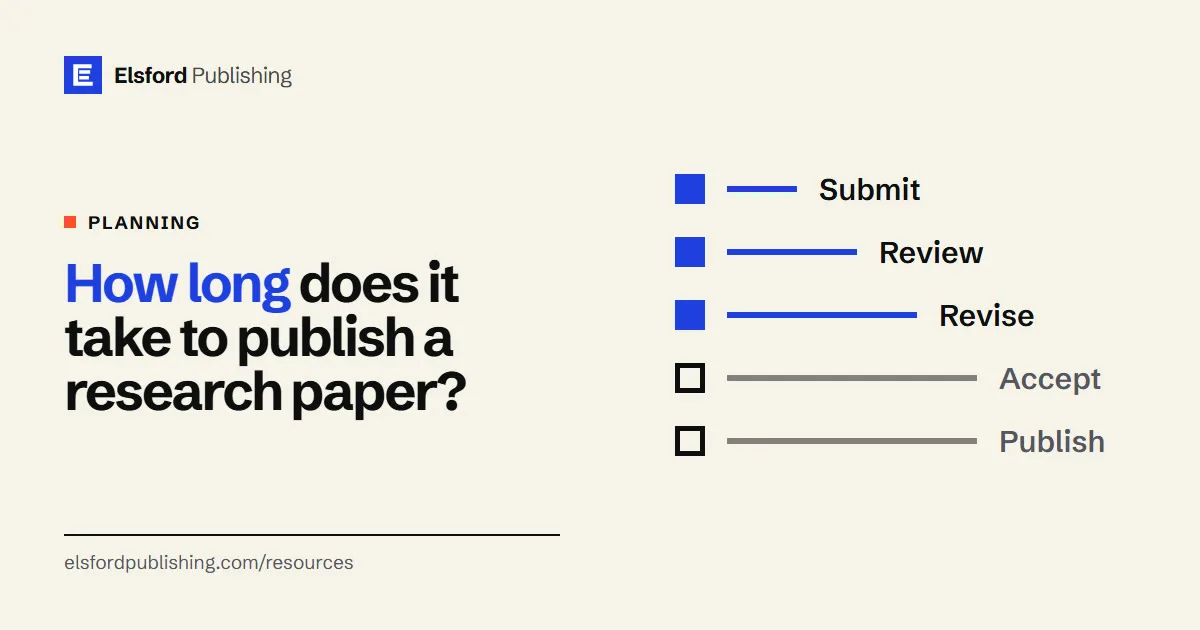
| Stage | Typical time | Who controls it |
|---|---|---|
| Preparing the submission | 1–3 weeks | You |
| Technical check and editor’s first read | Days to 2 weeks | Journal |
| Peer review, first round | 1–4 months | Journal and reviewers |
| Revisions | 2–8 weeks | You |
| Second review and decision | 2–8 weeks | Journal |
| Proofs and online publication | 2–6 weeks | Journal and you |
Added together, a typical path from submission to published article is somewhere between three months and a year, with many journals sitting around five to eight months. Some fields and journals are much faster; others, especially in the humanities and some social sciences, can take longer.
These are general ranges. Each journal is different, and many publish their own average times to first decision and to acceptance on their website.
Where the time is really lost
The longest delays rarely come from a single slow review. They come from starting again:
- A desk rejection for scope costs the time to reformat and resubmit elsewhere.
- A rejection after review at an unsuitable journal can cost three months or more.
- Incomplete submissions returned at the technical check add days or weeks each time.
Two rejections before finding the right journal can easily add six months. This is why journal selection matters more for your timeline than anything else you control.
What you can do to move faster
- Choose the journal deliberately. Match scope, article type and audience before you consider metrics. Our guide on desk rejection explains why.
- Check published review times. Where a journal states its average time to first decision, use it to compare options.
- Submit a complete package. Every declaration, figure file and statement ready the first time.
- Turn revisions around promptly. Journals usually allow 30 to 60 days for revisions; finishing well inside that window saves weeks.
- Respond to every reviewer comment. A thorough first response avoids a second round. See how to respond to reviewer comments.
Be wary of guarantees
Peer review takes time because independent experts are reading your work carefully. A service that guarantees acceptance, or promises publication whatever the reviewers decide, should make you cautious. Estimates that depend on peer review are useful; guarantees are not something anyone outside the journal can give.
Planning around a deadline
If you have a fixed date, work backwards. Allow at least the upper end of the ranges above, and choose journals whose published review times leave a margin. If the deadline is very close, talk to us early: a free assessment includes an honest view of which journals are realistic in the time you have.
Want a second opinion on your manuscript?
Send it for a free assessment. We will tell you honestly where it stands and which journals suit it.
Request a free assessment