Submission
How to write a cover letter for journal submission (with template)
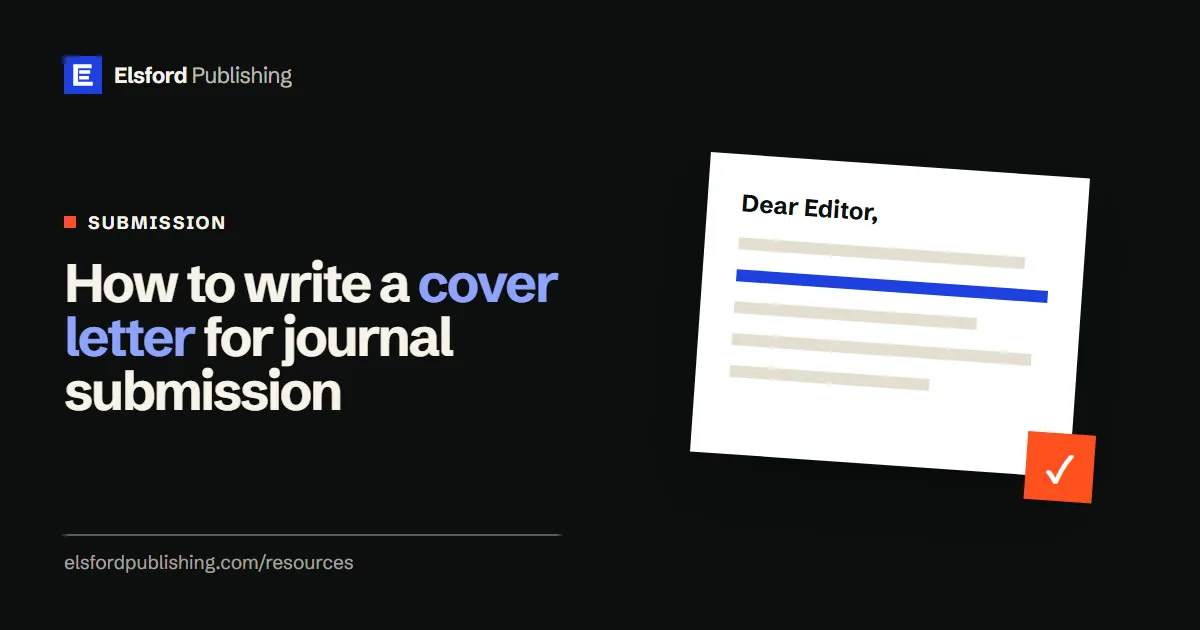
The cover letter is the first thing many editors read, often before they open the manuscript. A good one takes a few minutes to read and answers the editor’s real question: does this paper belong in my journal, and is it worth my reviewers’ time?
What the editor wants to know
Keep the letter to a single page and make sure it covers:
- What you submitted: the title and article type.
- What you found: the main finding in one or two plain sentences.
- Why it matters to this journal: the link to the journal’s scope and readers, ideally naming one or two recent articles in the journal that your work builds on.
- The required statements: that the work is original, not under consideration elsewhere, and approved by all authors, plus anything the journal specifically asks for.
What to leave out
- Copying the abstract. The editor already has it. Explain the significance instead.
- Overclaiming. “Ground-breaking” and “revolutionary” make editors more sceptical, not less.
- A generic letter. If the journal’s name could be swapped for another without changing a word, rewrite it.
- Long methodological detail. Mention the design in a phrase; the manuscript does the rest.
A template you can adapt
Dear Dr [Editor's surname],

Please find enclosed our manuscript, "[Title]", which we submit for
consideration as an [article type] in [Journal name].

In this study, we [what you did, in one sentence]. We found that
[main finding in plain language]. To our knowledge, this is the first
study to [the specific gap you address].

We believe the manuscript will interest the readers of [Journal name]
because [link to the journal's scope]. It builds on recent work published
in the journal, including [Author et al., Year], by [how it extends it].

This manuscript is original, has not been published, and is not under
consideration elsewhere. All authors have approved the submission and
declare no conflicts of interest. [Ethics approval / funding / data
availability statement, as required by the journal.]

Thank you for considering our work.

Yours sincerely,
[Name], on behalf of all authors
[Position, institution, email, ORCID]
Small details that make a difference
- Address the editor by name. It is on the journal’s editorial board page and takes a minute to find.
- Match the journal’s language. If the aims and scope talk about “translational impact”, use that framing where it is honest to do so.
- Mention reporting guidelines if your study type has one (CONSORT, PRISMA, STROBE and so on).
- Suggest reviewers carefully, if asked. Choose independent experts who are not recent collaborators.
- Check the journal’s own requirements. Some ask for specific statements in the cover letter itself.
If you are resubmitting after rejection
Write a new letter for the new journal. Do not mention the earlier rejection unless the journal asks for submission history or you are using a transfer service between journals of the same publisher.
A strong cover letter will not save a paper sent to the wrong journal, which is why scope comes first: see the most common reasons for desk rejection. If you would like your cover letter and full submission package prepared with you, take a look at our submission service.
Want a second opinion on your manuscript?
Send it for a free assessment. We will tell you honestly where it stands and which journals suit it.
Request a free assessment